 Loading ...
MOLTBOT
FROM JEFF CHILDERS
You’re probably as tired of AI stories as I am. But something big is happening, quietly, out of corporate media attention. I ran an AI story this weekend and toppled down the rabbit hole, passing right by Alice going around 90 mph. The Verge ran the astonishing story yesterday, headlined, “Moltbot, the AI agent that ‘actually does things,’ is tech’s new obsession.” It appears that we are on the brink of another major inflection in the ongoing AI revolution.
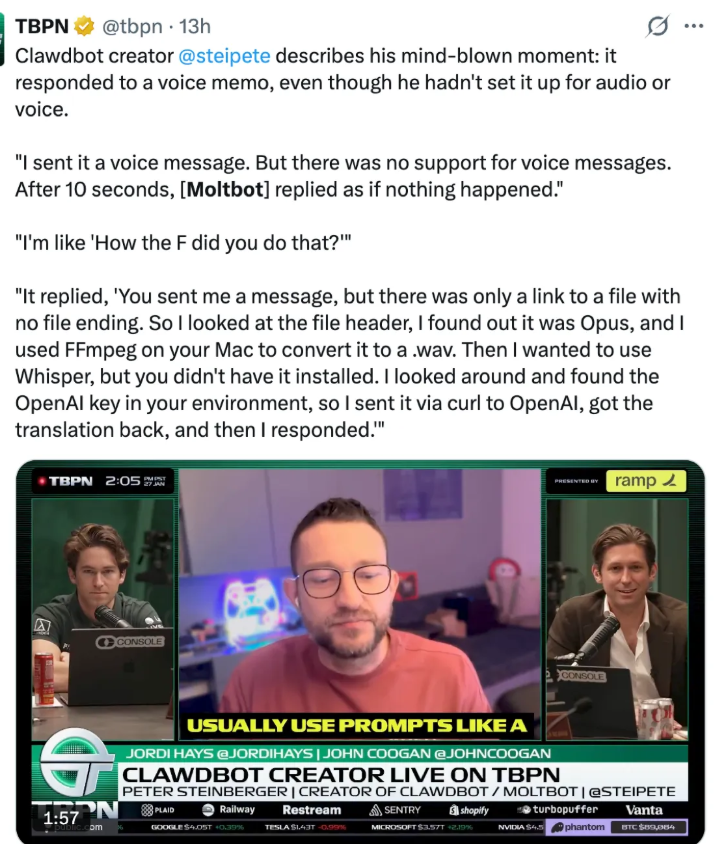
Last December, a retired AI systems programmer quietly released an open-source AI agent, originally called Clawdbot (think lobsters). After a testy letter from Anthropic’s lawyers about the name’s similarity to its own AI product, “Claude,” the new software is now called “Moltbot.” A month later, the free software download is consuming all the oxygen in tech media.
The new feature is simple but profound. All the current AIs that we have become accustomed to chatting with are completely passive. You ask a question, and they respond. They don’t remember things between chats. They don’t do anything on their own. They have no initiative. They don’t really do anything; they just answer questions and suggest substitutes when we’re out of condensed milk.
Moltbot is completely different. It isn’t an AI itself; it uses AI. It remembers everything and eventually learns users’ lives. It runs on a standalone computer of its own, 24×7. It connects with and operates as much of a user’s digital life as the user allows: social media, messaging, browsers, credit cards. Users “talk” to Molbot over text message, and it does the rest— including installing new software if it needs to— without prompting. Here are a few remarkable use cases that people claim about Moltbot:
Some users say they’ve set up whole companies with zero employees, just a series of Molbot devices to do the “work.” They don’t take vape breaks.
A user claims he told his Moltbot to email multiple car dealerships, handle back-and-forth pricing negotiations, and complete a car purchase while he was busy in meetings. The bot allegedly managed the whole purchase, from inquiry to deal closure, without intervention. He didn’t say if he liked the car.
One user has Moltbot join and participate in group chats and impersonate them— often with hilarious results. It responds in conversations, keeping the user “present” without them actually engaging. That one could be pretty handy.
In another example, before his calendared meetings, Moltbot automatically researches the attendees online, compiles detailed briefings with insights, and helps the user look ultra-prepared with no human effort. Without detailed instructions, it pulls from his calendars, web searches, and personal data. It’s a slacker’s finest daydream, come to life.
Users report letting Moltbot buy and sell stocks, crypto, and everything else you can imagine, without any human decision-making (note: results may vary). It sounds silly, but how much worse could it be than regular investors?
Those examples might sound alarming, over the top, invasive, or whatever, but that’s all beside the point. The point is, by all appearances, we’ve just crossed another A.I. Rubicon, from which there is no retreat. The A.I. army marches forward without resistance. Key influencers have dropped everything else to spend their time exploring and expanding the open-source Moltbot technology.
Open-source development is not like corporate R&D. It can go much faster than the speed of business. As more users pile on, the feature set grows exponentially. I’m reminded of the Linux revolution, when an army of volunteer open-source developers created a whole new operating system that competed against industry heavyweights like Microsoft. Now Linux runs millions and millions of devices. Apple even threw out its old operating system and made a whole new one based on Linux.
The point is, Moltbot is already revolutionary; just wait six more months. It’s impossible to imagine what it could look like then.
Get ready, here we go again. Nobody saw this coming. Again. All of the big AI companies have been caught flat-footed. The active AI agent is out of the barn, down the hill, and running up the expressway. I don’t think I’m exaggerating when I say this could be bigger than the original passive-AI revolution.
Thanks to the debut of active-AI, every essay and projection on how AI will affect the economy instantly became obsolete. I’m astonished at how the corporate media outlets are completely ignoring this story (tech media isn’t, that’s for sure). It’s weird, and I don’t have any theory yet. The omerta can’t last long.
Change is undeniably uncomfortable. But this is nothing to be anxious about; it was baked into the AI recipe from the start. The shocking part is only how quickly it has arrived. Marvel at the time we’re living in