WHAT’S THE DIFFERENCE BETWEEN THE INSURRECTION ACT AND MARTIAL LAW ?
THIS CLEARS UP SOME CONFUSION I HAVE ABOUT THESE DISTINCT EVENTS
Difference Between Enacting the Insurrection Act and Martial Law
Both the Insurrection Act and martial law involve extraordinary measures by the government, especially during times of civil unrest or emergency. However, they have distinct legal frameworks and implications.
Insurrection Act
Definition: The Insurrection Act is a set of laws allowing the President to deploy military forces to suppress civil disorder, insurrection, or rebellion when state authorities are unable or unwilling to maintain public order.
Authority: The President invokes this act under specific conditions, usually after attempts to rely on state resources have failed.
Usage: Historically used in events like the desegregation of schools in the 1960s and during riots.
Limitations: It’s intended for limited situations and typically requires a declaration from the President, who can only act with the goal of restoring order and enforcing the law.
Martial Law
Definition: Martial law is the imposition of military control over civilian functions, often enacted in response to emergencies, such as natural disasters or widespread civil disorder.
Authority: It can be declared by either a governor or the President, depending on the severity and scale.
Scope: Under martial law, military officials essentially take over governance, and civil law may be suspended. Citizens may face curfews, restrictions on movement, and military tribunals.
Duration and Conditions: It is generally intended for more extended periods and may remain in effect until order is restored.
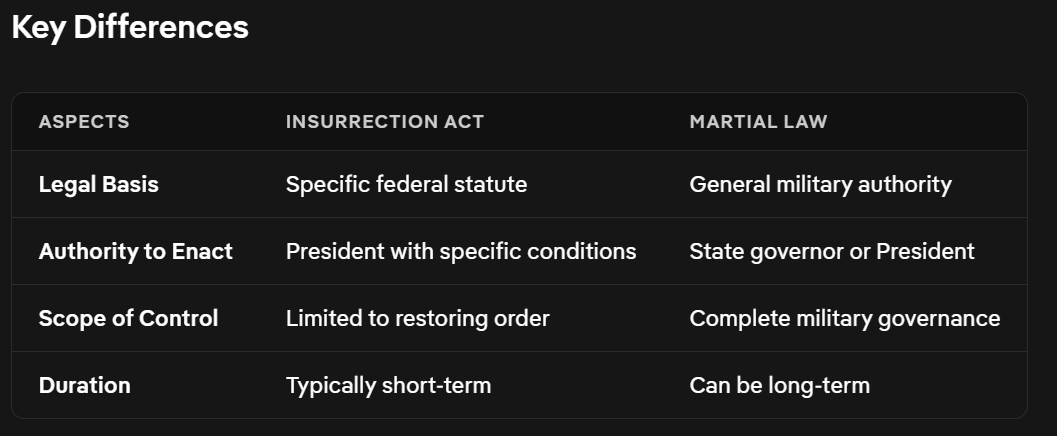
Ultimately, while both measures deal with civil unrest and emergency situations, the Insurrection Act is focused specifically on restoring order, whereas martial law encompasses a broader military control over civilian affairs.
Helpful information for mid-2026?