NO ONE EVER LOOKS FOR THE GOOD NEWS IN THE ECONOMY…
SO FUCK YOU NO ONE…HERE’S THE GOOD NEWS…FROM JEFF CHILDERS
The week has been practically bursting with great economic news. As we just saw, it took three Wall Street Journal reporters —David Uberti, Justin Lahart, and Aaron Zitner— to discover, weeks before the midterms, that gas, mortgages, and dinner out (“almost everything”) still cost money. What the trio of reporters somehow could not find room for, in a newspaper that sheds charts the way other people shed carbon dioxide, was the rest of the dashboard. Our first omitted example appeared in Wednesday’s Investing Live, which reported, “Atlanta Fed GDPNow estimate for Q3 growth jumps to 5.1% from 4.4%.”
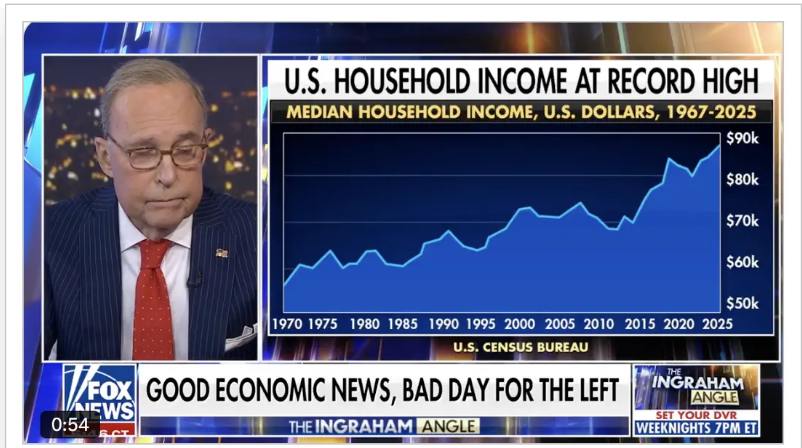
5.1% growth is a lot. On Laura Ingraham’s show, Larry Kudlow called it an economic boom. Retail sales are running around 6%, business investment in machinery, equipment, and data centers is up over 20%, productivity is up about 3% a year for almost two years running. It’s the kind of revolutionary clip America has not seen since the boom of the Reagan ’80s, which was itself historic, and which rewrote economic textbooks about what was considered possible to achieve through government policy.
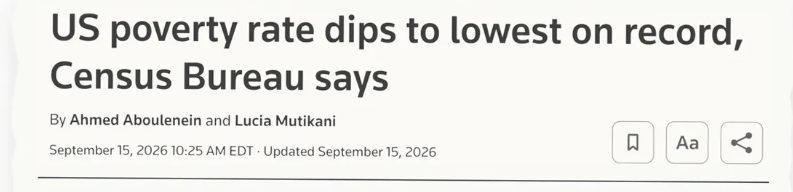
Then came the Census Bureau, announcing even more shattered records. On Tuesday, the agency announced that real median household income hit $87,460— up +2.6%, reaching the highest on record since 1967. Not only that, but the official poverty rate fell half a point to 10.2%. Reuters, not exactly a Trump Super PAC, headlined it as the lowest poverty rate on record.
Treasury Secretary Scott Bessent did not make it up. Looking pleased as punch (as well he might), he read the specific numbers out loud to congressmen: poverty down -50 basis points, real median income up +$2,250, black incomes were up +4.8% —the highest of any group— and whites were also up +2.9%. Child poverty has hit its lowest figures in history. Hispanic poverty also hit a historic low.
https://x.com/USTreasury/status/2099989082264805689
The Journal’s contribution to this record-breaking financial data dump was a vibe check on the price of fast-food hamburgers and a single Michigan retiree rage-voting for a socialist.
So yes, gas is expensive, because we are finally stopping Iran from getting nukes and oil markets have opinions. Interest rates bumped up— in order to slow inflation. Dinner costs what dinner costs. None of that needed a three-byline special. What did require three bylines was the narrative decision to frame a booming, high-income, falling-poverty economy as a midterm horror story about the price of avocado toast— while burying the Atlanta Fed, the Census Bureau, and the highest real median household income in American history under the mattress with the spare adjectives.
Maybe it was a staffing problem. Maybe, if they had assigned a fourth reporter, they could have found the big story.