Gold Daily Call for September 2nd, 2026
Welcome back – we hope you all had a restful summer and were able to recharge.
Our daily call series resumes today. Going forward, we will publish our daily updates on gold and silver again via Substack, X, LinkedIn and Telegram. Please note that occasional interruptions may occur when we are traveling or attending conferences.
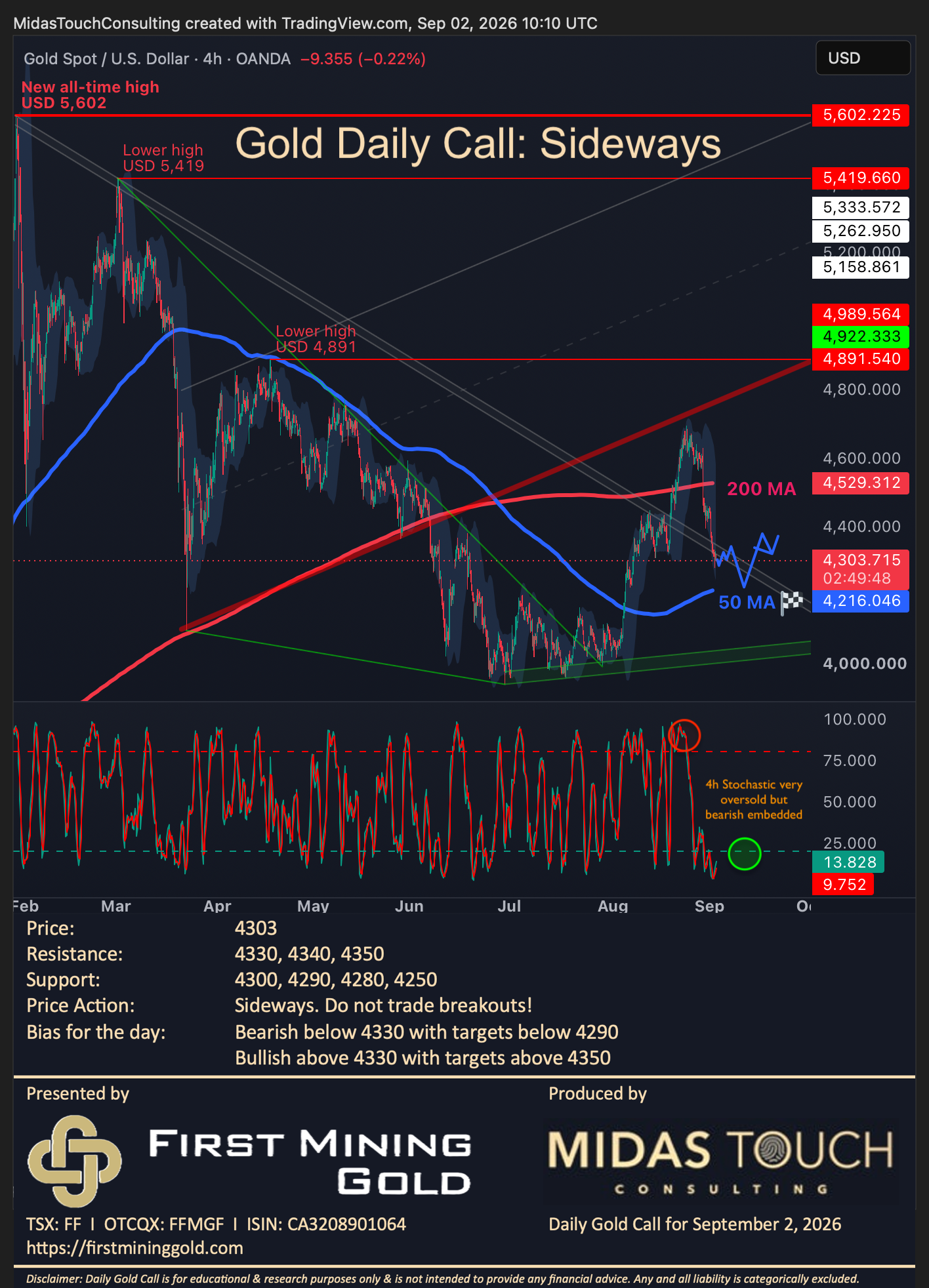
As often happens, the anticipated “summer rally” in gold began almost immediately after we went on holiday. In just three weeks, gold surged from around USD 4,020 to USD 4,697. We had set a modest minimum target of USD 4,500 and said we wanted to see how this summer rally would unfold. In hindsight, the rally behaved more like a short-covering squeeze than a sustainable climb along a wall of worry.
Consequently, the sharp pullback from the USD 4,697 high last week is not surprising. Although gold had briefly reclaimed its 200-day moving average (200MA), that level offered little support once selling pressure intensified during Jackson Hole. Gold is now down roughly USD 400 in a single week, with no clear sign yet of a bottom or reversal. We therefore expect gold to test its rising 50-day moving average (50MA) around USD 4,218 and the lower daily Bollinger Band (USD 4,203) sooner rather than later. However, gold is very oversold on the smaller timeframes and the daily stochastic switched extremely fast from overbought into oversold. That means shorting at current levels does not deliver a good risk/reward anymore. But we need to understand that even in the short-term there is another USD 100+ downside risk. Of course, at some point gold will bounce and recover some of the lost ground. Best case would be a relief bounce back toward the 200MA slightly above USD 4,500. If the rising 50MA does not hold, the door USD 4,000 would be wide open again (worst case).
In the bigger picture, the series of lower highs remains intact. For September, we anticipate gold oscillating between the 50MA and 200MA. The next directional impulse will likely depend on equity-market behavior. Historically, the two months preceding U.S. midterm elections tend to bring stock market pullbacks. Given already elevated global uncertainty, additional stress in risk assets spilling over into precious metals would not be unexpected.. At some point, Fed and Treasury Secretary Bessent may be forced to step in with liquidity support, though.
Overall, we are rather cautious going into September. The September Effect refers to the historical tendency for stock markets—especially U.S. equities like the S&P 500 and Dow Jones—to post weaker or negative average returns in September compared with other months. Over long data series, September is the only calendar month with a negative average return for the S&P 500, and it also has one of the highest frequencies of down months.
https://floriangrummes.substack.com/p/gold-daily-call-for-september-2nd
WELCOME BACK TO THE TENT MIDAS 🙂
Thank you!
Yes, THANK YOU. Looking forward to your insights !
Thank you!